

by Jonathan Krall
Update (May 2026): City council approved Braddock Road East! Our new concern is Braddock Road West.
Act: Visit betterbraddock.org and “add your voice.”
It takes six years to forget. In 2014, Alexandria planned bike lanes on a short segment of King Street, from Cedar to Janney’s Lane. Well-connected, car-dependent Alexandrians in that wealthy neighborhood objected to the loss of 27 rarely-used parking spaces, raising a fracas loud enough to reach the pages of the Wall Street Journal. In the 2015 election the following year, an anti-bicycle crusader ran for city council. In a race with 6 winning slots, he came in 10th. In 2019, a similar fracas was raised over bike lanes on Seminary Road, this time reducing general traffic lanes. Misinformation ran rampant. Yet another crusader ran for city council, coming in 10th. In 2026, we’re doing it again. This time, bike lanes are planned for Braddock Rd, removing on-street parking. While we argue (again) over bike lanes and learn (again) that people want them, we might be missing the real lesson. The lesson isn’t that people need bike lanes, it’s that people need a useful cycling network.
Just like in 2014 and 2019, development of the bicycling network by Alexandria city staff is guided by the city’s Transportation/Mobility, Complete Streets and Vision Zero plans and policies. As in 2014, most of the homes have off-street parking. As in 2014 and 2019, opponents say very few people ride bicycles there. People who actually ride bicycles say they avoid this dangerous street (I know I do). As always, we get misinformation, testimony, and facts.
The deck is stacked
As usual, anti-change activists decry the process. The fix is in. City staff have already decided on bike lanes. I myself often say that the deck is stacked in favor of people in cars. Because we are referring to two different things, we are both right. The environment that surrounds us–street design, relentless advertising, everywhere-visible gas prices–elevates the automobile. People driving cars get a robust network of roads, a map (no small thing), and apps to help them along the way. People bicycling get a map (in 2010, Google maps added a bicycling layer).
In some cities, bike lanes are connected. Placed side-by-side, on the same scale, a Minneapolis map shows a network, albeit of limited scope. The Alexandria map shows fragments

Alexandria (left) and Minneapolis (right), on the same scale. The Google “Bicycling” layer (accessed the same way as the “Traffic” layer in google maps) shows bike lanes (green lines). Minneapolis has a network. Alexandria has a work in progress.
Because it is natural to correct imbalances and to build useful things we do not yet have, and because we do not have a useful bike lane network, the decision-making process is indeed skewed in favor of bike lanes. But it’s also a compromise process that values progress without clearly defining success. Instead of a useful network of bike lanes, we have a network of compromises. If we keep designing gaps into the network, we will never succeed. We need to compromise without abandoning success.
Success?
A working bicycle network provides countless benefits. It allows children to safely ride to school, including children riding the “Brooks Bike Bus” to Naomi Brooks Elementary School. It gives adults the option to cycle, scoot, or wheelchair past traffic, with or without an electric assist. A bicycle network eases and expands the path from home to the nearest Metro or bus stop. For many, this is all more fun than sitting in traffic. People on scooters enjoy fresh air. People on trains enjoy people-watching and reading books. Because people on bikes, or on a bus, take up much less space than the same number of people in cars, bike lanes, buses, and subways (and sidewalks) are high-capacity transportation. This is perhaps easiest to see on King Street in Old Town, where the sidewalk almost always holds many more people than the adjacent traffic lane. Just as the road network supports commerce and brings in tax dollars, the sidewalk/bike lane/transit network supports commerce and brings in more tax dollars. Bike-friendly cities are attractive.
Wheelchair?!?
Above, we noted that people in cars get a network, a map, and an endless stream of feel-good, pro-car propaganda. People on bicycles don’t get a network, but do get a map. But there’s more to the story: people who depend on the ADA-compatible sidewalk network don’t even get a map. Bike-lane opponents say we should respond by making driving and disability parking as convenient as possible. The disability community says we need universal design. Universal design integrates people with disabilities into the street design process to ensure that these critical social spaces are inclusive. Along with people walking, people on mobility devices (scooters, bicycles), people on transit, and people in cars, universal design includes people with disabilities. While universal design includes bike lanes, bike lanes do not make up for substandard sidewalks. Yes, people in wheelchairs sometimes use a bike lane to get around a sidewalk obstacle. No, bike lanes do not relieve us of our obligation to build an ADA-compatible sidewalk network.

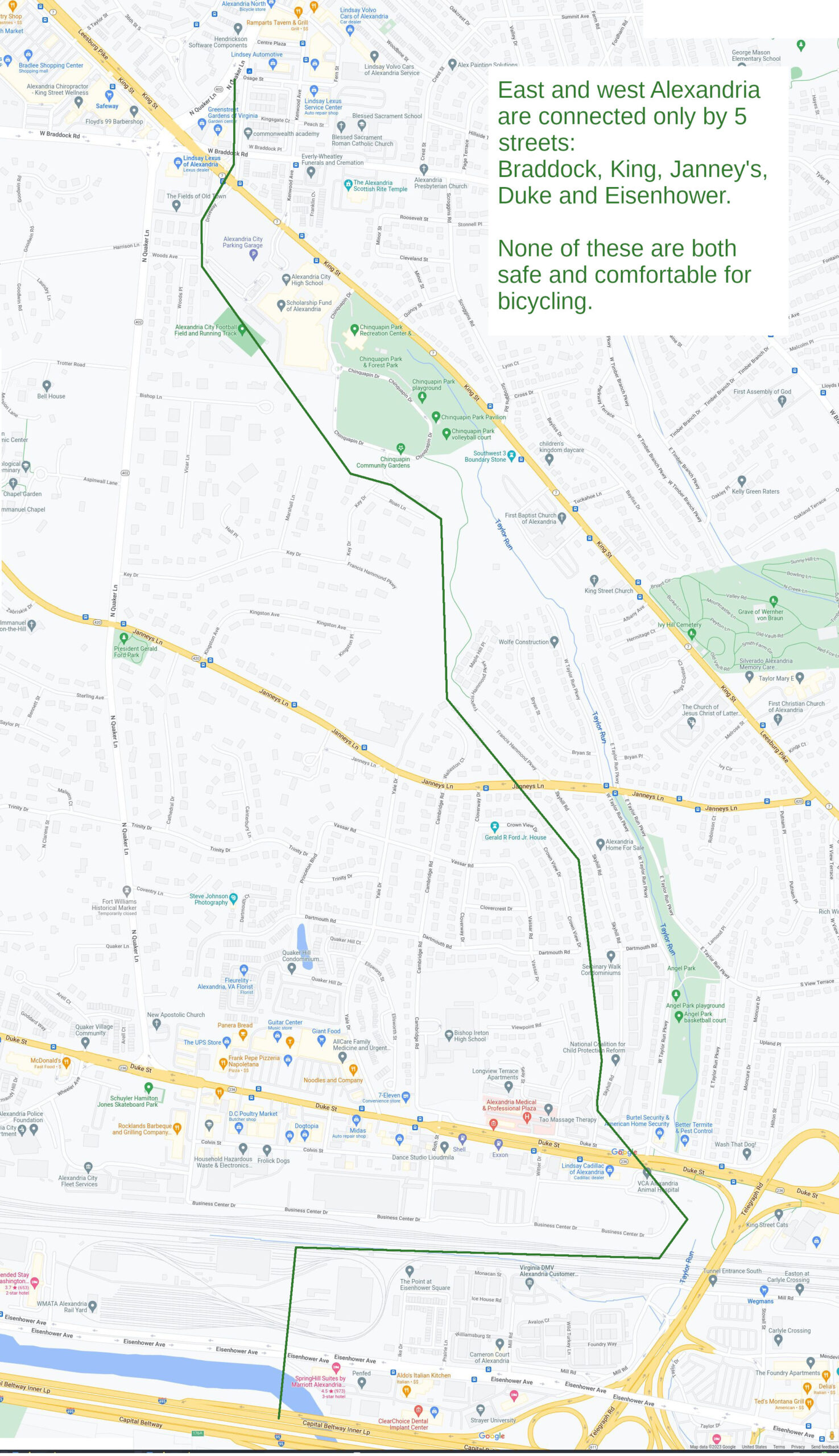
The crooked green line on this map of Alexandria, extending from Quaker Lane to Cameron Run, divides east from west. Only five streets cross this line. Click here for a more detailed map.
Do we have to fight like this?
Sadly, the answer is probably yes. Back in 2021, a prominent bike lane-opponent “said he would be in favor of a few north-south and east-west routes, but that the current expansion of bike lanes in the city are too disruptive for the city’s arterial roads.” In fact, east and west Alexandria are connected by only 5 streets: Eisenhower, Duke, Janney’s/Seminary, King, and Braddock. None are both safe and comfortable for bicycling. Every few years, a bike lane project on one of these streets triggers a major fight: King in 2014, Seminary in 2020, Braddock in 2026 (I’m not looking forward to 2032). Every time, the opposition, small but loud, say they like bike lanes, but not on this street. While the opposition correctly states the importance of these major streets, they incorrectly imply that “better options exist.” They do not. If we want to enable mobility for people who prefer to avoid driving, and attain the economic benefits of a stronger transportation network, we must open these streets to people of all kinds.
Will we ever succeed?
We have the people. You can see them riding bicycles on Commonwealth Ave, even in the part without bike lanes (but if you ask them, they’ll tell you they prefer the part with bike lanes). Every day I see more families doing their best to raise physically fit children. When I attend a civic “ICE Out” or “housing for all” meeting, I see that I am not the only one to bicycle to the meeting. When I park my bicycle at MOMs or at the Potomac Yard Giant, I see others shopping by bicycle.
In cities across the US and around the world, robust bicycle transportation networks are becoming necessary public amenities. Our own fragmented cycling network serves those brave enough to ride in traffic, through places where the cycling network has yet to reach. If we are brave enough to speak up now, someday we won’t need to be particularly brave to simply enjoy a bike ride. We have the people. We see them in the election results. If we see them speaking up in public, perhaps, this time, our elected leaders will approve a bike lane without a gap.
I totally agree with this – it’s just common sense!